Top 10 AI Tools for Audio for 2026


The world of audio is experiencing a massive shift. Artificial intelligence is transforming how we create, edit, and experience sound. From podcast production to music composition, AI-powered tools are streamlining workflows and opening new creative possibilities. Get ready to discover the top 10 AI audio tools of 2026 that will supercharge your audio projects. For specialized audio content analysis, explore our comprehensive guide to the best audio summarizer tools for 2026, which covers AI solutions for podcasts, interviews, and audio content extraction.
Introduction
AI is changing the way we work with audio. These powerful tools can simplify complex tasks and offer new creative possibilities for podcasters, musicians, and video editors alike.
What are AI audio tools? They use advanced algorithms to automate tasks like noise reduction, audio mastering, sound effect generation, and even music composition.
This blog reviews the top AI audio tools available in 2026. We’ll discuss their features, strengths, and best use cases to help you find the perfect tool to improve your audio projects. For users interested in AI-powered note-taking from audio content, our comprehensive guide to AI that listens and takes notes covers specialized solutions for transcription and automated note generation. If you need to extract audio from YouTube videos, check our YouTube to WAV converter guide for lossless audio extraction.
Top Tools at a Glance
| Tool name | Overview | Pricing | Best For | Rating |
|---|---|---|---|---|
| ScreenApp | All-in-one screen recorder and audio editor with AI features. | Free tier available | Content creators, educators, marketers. | ★★★★★ |
| Adobe Podcast | AI-powered audio enhancement and podcast editing. | Free (1hr/day), Premium $9.99/mo | Podcasters, voice content creators. | ★★★★★ |
| Descript | Text-based audio and video editing with AI features. | Free tier, Paid from $12/mo | Podcasters, video creators. | ★★★★★ |
| ElevenLabs | Ultra-realistic AI voice generation and text-to-speech. | Free (10k chars/mo), Paid from $5/mo | Audiobook producers, content creators. | ★★★★★ |
| Suno | AI music generation from text prompts. | Free tier, Pro from $10/mo | Musicians, content creators, game developers. | ★★★★☆ |
| LANDR | AI-powered audio mastering and distribution. | $9.99/track, $12.99/mo unlimited | Musicians, podcasters. | ★★★★☆ |
| Cleanvoice | AI podcast editor that removes filler words and noise. | From €10/mo | Podcasters, audio editors. | ★★★★☆ |
| AudioSculpt | Professional audio restoration and enhancement. | Part of IRCAM Premium subscription | Audio archivists, sound designers. | ★★★★ |
| Fish Audio | Professional voice cloning and text-to-speech. | From $5.50/mo | Voice actors, content producers. | ★★★★ |
| AudioCipher | Text-to-MIDI generator for music composition. | VST plugin purchase | Music producers, composers. | ★★★★ |
Top 10 AI Tools
1. ScreenApp
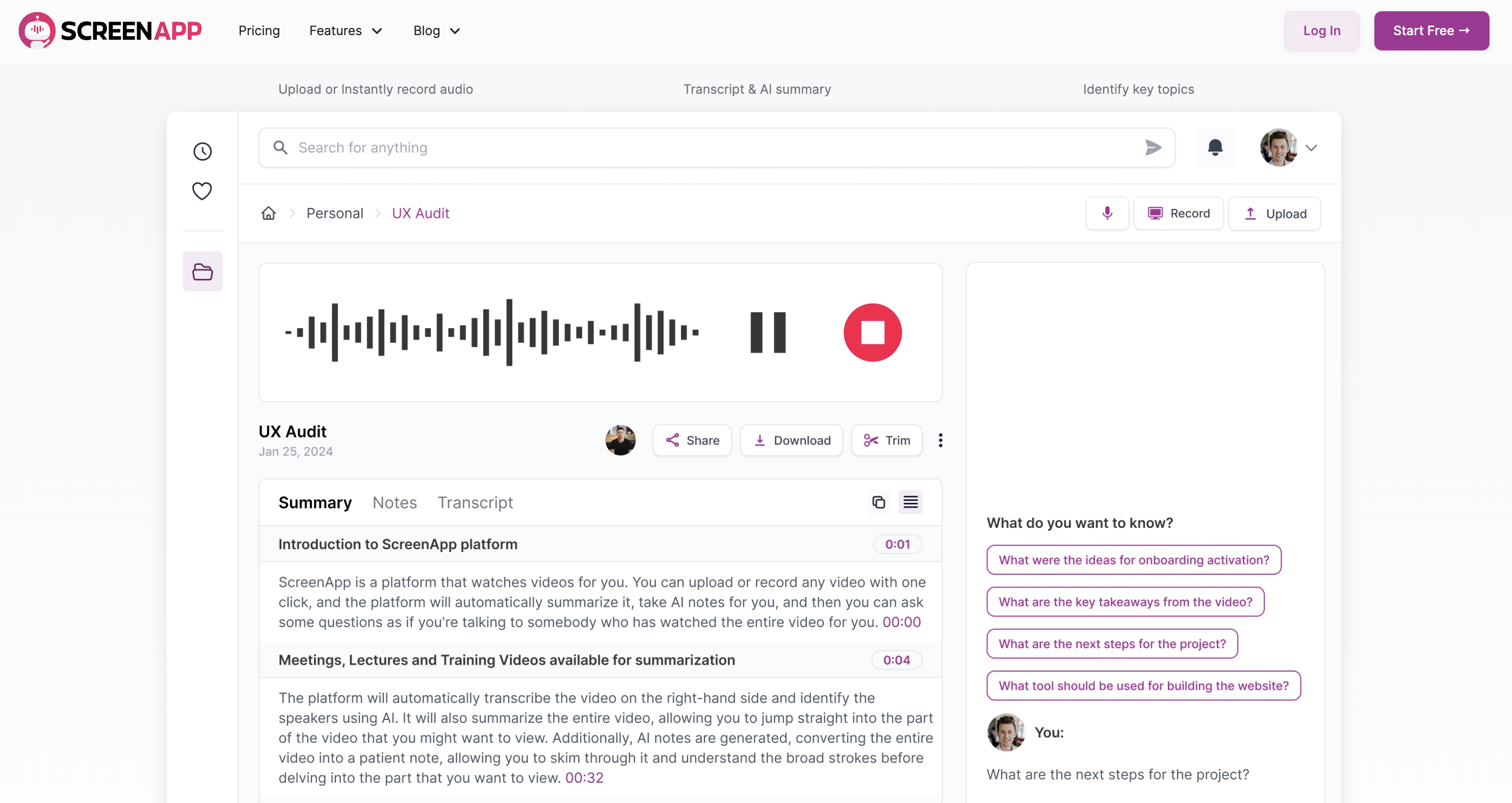
Short Summary: ScreenApp is an all-in-one screen recorder and audio editor built with AI-powered features. It excels in effortless audio capture and voiceover generation.
Pros:
- Simplifies audio creation with screen recordings alongside webcam and mic input.
- Streamlines post-production with AI-based noise reduction, automated transcription, and intuitive editing.
- User-friendly interface designed for non-technical users.
Cons:
- May have fewer advanced features compared to more complex audio editing software.
Pricing: Free tier available with premium features.
Best For: Content creators, educators, marketers, or anyone who needs to create presentations and tutorials with voice-over.
Personal Assessment: A fantastic choice for efficiency and ease of use in creating professional-quality audio integrated with screen recordings.
Rating: 5/5
2. Adobe Podcast
Short Summary: Adobe Podcast is Adobe’s AI-powered audio enhancement tool that removes background noise and improves voice clarity with one click. It has become a go-to solution for podcasters in 2026.
Pros:
- Enhance Speech removes background noise and improves clarity automatically.
- Free tier processes up to one hour daily with 30-minute file limit.
- Mic Check helps optimize recording settings before you start.
- Integrates with Adobe Creative Cloud for seamless workflows.
Cons:
- Free version has daily processing limits.
- Premium features require subscription.
Pricing: Free (1 hour/day), Premium $9.99/month or $99.99/year (4 hours/day).
Best For: Podcasters, voice content creators, and remote interviewers.
Personal Assessment: Adobe Podcast has become the industry standard for quick audio enhancement, offering professional results with minimal effort.
Rating: 5/5
3. Descript
Short Summary: Descript is a text-based audio and video editor that lets you edit recordings by editing text. It has become one of the most popular audio editing tools in 2026.
Pros:
- Edit audio by editing the transcript, making editing accessible to everyone.
- Studio Sound removes noise and enhances voices with AI.
- Automatically removes filler words like “um,” “uh,” and “like.”
- Includes screen recording and video editing features.
Cons:
- Free plan limited to 1 hour of transcription per month.
- Advanced features require paid subscription.
Pricing: Free (1 hour transcription), Hobbyist $12/month, Creator $24/month, Business $55/month.
Best For: Podcasters, video creators, and anyone who wants to edit audio without technical expertise.
Personal Assessment: Descript has transformed audio editing by making it as easy as editing a document. The text-based approach is intuitive and saves hours of work.
Rating: 5/5
4. ElevenLabs
Short Summary: ElevenLabs offers ultra-realistic AI voice generation with exceptional emotional control and natural-sounding output. It has become the leading voice AI platform in 2026.
Pros:
- Industry-leading voice quality with natural emotion and expression.
- Supports multiple languages and custom voice cloning.
- Fast generation with low latency under 500ms.
- Conversational AI pricing recently reduced by 50%.
Cons:
- Free tier limited to 10,000 characters per month.
- Custom voice cloning requires paid plan.
Pricing: Free (10k chars/month), Creator $11/month (100k credits), Pro $99/month (500k credits), Scale $330/month.
Best For: Audiobook producers, content creators, game developers, and accessibility applications.
Personal Assessment: ElevenLabs sets the standard for AI voice generation. The voices are remarkably natural and expressive, making it hard to distinguish from human recordings.
Rating: 5/5
5. Suno
Short Summary: Suno is the leading AI music generation platform in 2026, allowing users to create full songs with vocals from simple text prompts.
Pros:
- Generate complete songs with vocals, instruments, and production.
- Wide range of styles and genres available.
- Pro plan includes commercial use rights.
- Can split songs into individual stems for remixing.
Cons:
- AI-generated music may lack the nuance of human composition.
- Free plan has limited monthly credits.
Pricing: Free (basic plan), Pro plan starts at approximately $10/month for 500 songs.
Best For: Content creators, game developers, videographers, and musicians looking for inspiration or royalty-free music.
Personal Assessment: Suno has transformed music creation in 2026. The ability to generate complete, production-ready songs from text is remarkable, though it works best as a starting point or for background music.
Rating: 4.5/5
6. LANDR
Short Summary: LANDR is an AI-powered mastering platform that delivers professional-grade audio finalization in seconds, along with music distribution services.
Pros:
- Analyzes your mix and applies intelligent adjustments for optimal loudness, balance, and clarity.
- Offers genre-specific presets and customization options.
- Unlimited mastering with subscription plans.
- Includes distribution to Spotify, Apple Music, and other platforms.
Cons:
- May not replace a skilled mastering engineer for complex projects.
- Pay-per-track option can be expensive for multiple songs.
Pricing: $9.99 per track, or Essentials $12.99/month (unlimited MP3), Pro $24.99/month (unlimited WAV/HD).
Best For: Musicians, podcasters, and content creators who want professional mastering without hiring an engineer.
Personal Assessment: LANDR offers excellent value for independent musicians and podcasters. The AI mastering is impressive for most projects, though professional releases may still benefit from human mastering.
Rating: 4.5/5
7. Cleanvoice
Short Summary: Cleanvoice is an AI podcast editor that automatically removes filler words, mouth sounds, and background noise, saving hours of editing time.
Pros:
- Automatically removes filler words like “um,” “uh,” and “like.”
- Removes mouth sounds, clicks, and lip smacks.
- Handles both audio and video podcast editing.
- Supports multi-speaker recordings.
Cons:
- Requires subscription for regular use.
- May occasionally remove words incorrectly.
Pricing: Plans start at €10/month, with Storyteller and Pro plans ranging from $11.99 to $23.99/month.
Best For: Podcasters and audio editors who want to automate the tedious parts of editing.
Personal Assessment: Cleanvoice is a huge time-saver for podcasters. It handles the repetitive cleanup tasks that would otherwise take hours of manual work.
Rating: 4.5/5
8. AudioSculpt
Short Summary: AudioSculpt is a professional audio restoration and enhancement tool from IRCAM, specializing in repairing damaged recordings and isolating sonic elements.
Pros:
- Advanced AI algorithms for repairing hisses, clicks, and audio artifacts.
- Precision tools for extracting vocals, instruments, or sound effects from complex mixes.
- Frequency spectrum sculpting for detailed sound shaping.
- Professional-grade results for restoration work.
Cons:
- Requires technical understanding for optimal results.
- Part of IRCAM Premium subscription (not sold separately).
Pricing: Included with IRCAM Forum Premium subscription (contact IRCAM for current pricing).
Best For: Audio archivists, forensic audio specialists, sound designers, and musicians working with samples.
Personal Assessment: AudioSculpt is a professional tool for serious audio restoration and sound design work. It offers capabilities beyond typical audio editors but has a learning curve.
Rating: 4/5
9. Fish Audio
Short Summary: Fish Audio offers professional-grade voice cloning and text-to-speech with exceptional emotional control and ultra-low latency under 500 milliseconds.
Pros:
- Professional emotional control for expressive voice output.
- Ultra-low latency makes it suitable for real-time applications.
- High-quality voice cloning capabilities.
- Affordable pricing compared to competitors.
Cons:
- Smaller voice library compared to ElevenLabs.
- Less well-known, though rapidly gaining popularity.
Pricing: Starting at $5.50/month for professional-grade features.
Best For: Voice actors, content producers, and developers building voice AI applications.
Personal Assessment: Fish Audio offers excellent quality at a competitive price point. The emotional control is impressive, making it a strong alternative to more expensive options.
Rating: 4/5
10. AudioCipher
Short Summary: AudioCipher is a text-to-MIDI generator plugin that helps musicians and producers create melodies and chord progressions by converting words into musical notes.
Pros:
- Unique approach to music composition using text input.
- Works as a VST plugin in major DAWs (Ableton, Logic Pro, FL Studio, etc.).
- Customizable scales, tempos, and musical parameters.
- Great for overcoming creative blocks.
Cons:
- Uses traditional cryptogram technique, not AI algorithms.
- Requires understanding of music theory for best results.
Pricing: One-time VST plugin purchase (check website for current pricing).
Best For: Music producers, composers, and beatmakers looking for creative inspiration.
Personal Assessment: AudioCipher offers a unique approach to music composition. While not AI-based, it provides an interesting tool for generating melodic ideas and breaking creative blocks.
Rating: 4/5
FAQ
What are AI audio tools?
AI audio tools use artificial intelligence and machine learning to automate audio tasks like noise reduction, transcription, mastering, voice generation, and music composition. They make professional audio production accessible to everyone, regardless of technical expertise.
Are free AI audio tools good enough?
Many AI audio tools offer free tiers that work well for occasional use. Adobe Podcast, Descript, ElevenLabs, and Suno all have free plans. However, paid plans typically offer better quality, faster processing, and commercial use rights.
What’s the best AI tool for podcast editing?
For 2026, Descript and Adobe Podcast are the top choices. Descript offers text-based editing and automatic filler word removal, while Adobe Podcast excels at audio enhancement. Cleanvoice is excellent for automated cleanup tasks.
Can AI-generated voices sound natural?
Yes. ElevenLabs and Fish Audio produce remarkably natural-sounding voices with proper emotion and expression. The technology has improved dramatically, making it difficult to distinguish from human recordings in many cases.
Can I use AI-generated music commercially?
It depends on the tool and plan. Suno offers commercial rights with their Pro plan. LANDR’s mastering includes full commercial rights. Always check the licensing terms for your specific use case and subscription level.
Do I need technical skills to use AI audio tools?
No. Most modern AI audio tools are designed for non-technical users. Tools like Adobe Podcast, Descript, and ScreenApp offer intuitive interfaces that anyone can use. Professional tools like AudioSculpt may require more expertise.
Conclusion
The world of audio is transforming rapidly, and AI audio tools are leading this change. From intuitive editing and restoration to intelligent music generation and sound design, these tools are breaking down barriers and changing how we create and interact with sound. For creators working with both audio and video content, explore our comprehensive analysis of the top 14 AI tools for video production in 2026, which covers advanced solutions for multimedia content creation workflows.
For professionals, AI audio solutions offer streamlined workflows, increased efficiency, and creative possibilities that were previously out of reach. Beginners can unlock their audio potential, turning complex tasks into accessible projects.
Don’t be afraid to experiment. Dive into the world of AI audio tools and discover which best suit your needs as a content creator, musician, podcaster, or audio enthusiast. The future of sound is here, and the possibilities are truly limitless.
For comprehensive audio note-taking solutions, explore our detailed guide to the top 10 audio notetakers for 2026, which covers specialized AI tools for capturing and organizing audio content into structured notes.
Recent developments: Mistral’s Voxtral Transcribe 2 (February 2026) delivers state-of-the-art transcription at $0.003/min with open-weights for on-device deployment. Speechify has expanded from TTS into a full AI platform including voice assistants and meeting transcription. And hardware AI notetakers are emerging as a new category of dedicated audio capture devices.
FAQ
AI audio tools use artificial intelligence and machine learning to automate audio tasks like noise reduction, transcription, mastering, voice generation, and music composition. They make professional audio production accessible to everyone, regardless of technical expertise.
Many AI audio tools offer free tiers that work well for occasional use. Adobe Podcast, Descript, ElevenLabs, and Suno all have free plans. However, paid plans typically offer better quality, faster processing, and commercial use rights.
For 2026, Descript and Adobe Podcast are the top choices. Descript offers text-based editing and automatic filler word removal, while Adobe Podcast excels at audio enhancement. Cleanvoice is excellent for automated cleanup tasks.
Yes. ElevenLabs and Fish Audio produce remarkably natural-sounding voices with proper emotion and expression. The technology has improved dramatically, making it difficult to distinguish from human recordings in many cases.
It depends on the tool and plan. Suno offers commercial rights with their Pro plan. LANDR's mastering includes full commercial rights. Always check the licensing terms for your specific use case and subscription level.
No. Most modern AI audio tools are designed for non-technical users. Tools like Adobe Podcast, Descript, and ScreenApp offer intuitive interfaces that anyone can use. Professional tools like AudioSculpt may require more expertise.