How to Convert Video to PPT: Best Free AI PowerPoint Converters 2026

Updated February 2026 with current pricing, new tools like Video2PPT and SlidesPilot, and verified feature comparisons.
You have a 45-minute training video. Your boss wants a slide deck by end of day. Rewatching the whole thing, pausing every 30 seconds to screenshot and type notes, takes hours. This is the problem that video to PPT converter AI tools solve. According to a 2026 Wyzowl report, 91% of businesses now use video as a marketing tool, which means more video content needs to be turned into shareable documents than ever before.
Over 500,000 presentations created. Business teams, educators, and content creators worldwide use these tools daily to turn hours of work into minutes.
This guide compares 7 tools that actually convert video to PPT automatically, with real pricing, honest pros and cons, and step-by-step instructions. If you need to convert a YouTube video to PowerPoint, turn an MP4 into slides, or extract a lecture recording into an editable deck, we tested each tool so you don’t have to. For a broader look at AI presentation makers, see our AI tools for presentations roundup.
Quick Picks
Best overall (direct PPT export): ScreenApp — Free plan, paid from $14/mo
Best for local processing: Video2PPT — Free, Pro $5/mo
Best for YouTube to slides: SlidesPilot — Free trial, Pro $15/mo
Best for video editors: Veed.io — Free plan, Lite $12/mo
Comparison Table
| Tool | Best For | Direct PPT Export | Free Plan | Price (Paid) |
|---|---|---|---|---|
| ScreenApp | Full pipeline (transcription + OCR + PPT) | Yes | Yes (1 transcript/mo) | $14/mo annual |
| Video2PPT | Local processing, privacy | Yes | Yes (200 MB limit) | $5/mo |
| SlidesPilot | YouTube video to slides | Yes | Trial | $15/mo annual |
| MagicSlides | Google Slides integration | Yes | Limited | $8/mo annual |
| Veed.io | Video editing + transcript | No (transcript only) | Yes (watermark) | $12/mo |
| Pictory.ai | Video repurposing for marketing | No (transcript only) | 14-day trial | $19/mo annual |
| Vizle | Frame extraction to PDF/PPT | Yes | Limited | $10/video |
Note: “Direct PPT Export” means the tool generates a .pptx file from video content automatically. Tools marked “No” require you to copy the transcript into a presentation manually.
How AI Video-to-PPT Works
Not all “video to PPT” tools work the same way. Basic converters just embed your video file on a single slide, which isn’t useful. A proper AI converter like ScreenApp uses a multi-step pipeline:
1. AI Transcription — Converts all spoken audio to text with high accuracy.
2. OCR (Text Recognition) — Reads any text visible on screen, which is useful for silent screen recordings and software demos.
3. AI Analysis and Slide Generation — Groups the combined text into logical topics and creates one slide per theme with summarized content.
4. Export with Timestamps — The final .pptx file includes clickable timestamps that link back to the exact moment in the original video.
This is a complete video-to-document pipeline, not just a transcript tool. It works especially well for training videos, lecture recordings, and webinar replays where you need structured slides with specific content from each section.
Step-by-Step: Convert Video to PPT
- Upload Video
- Convert
- Select AI Template
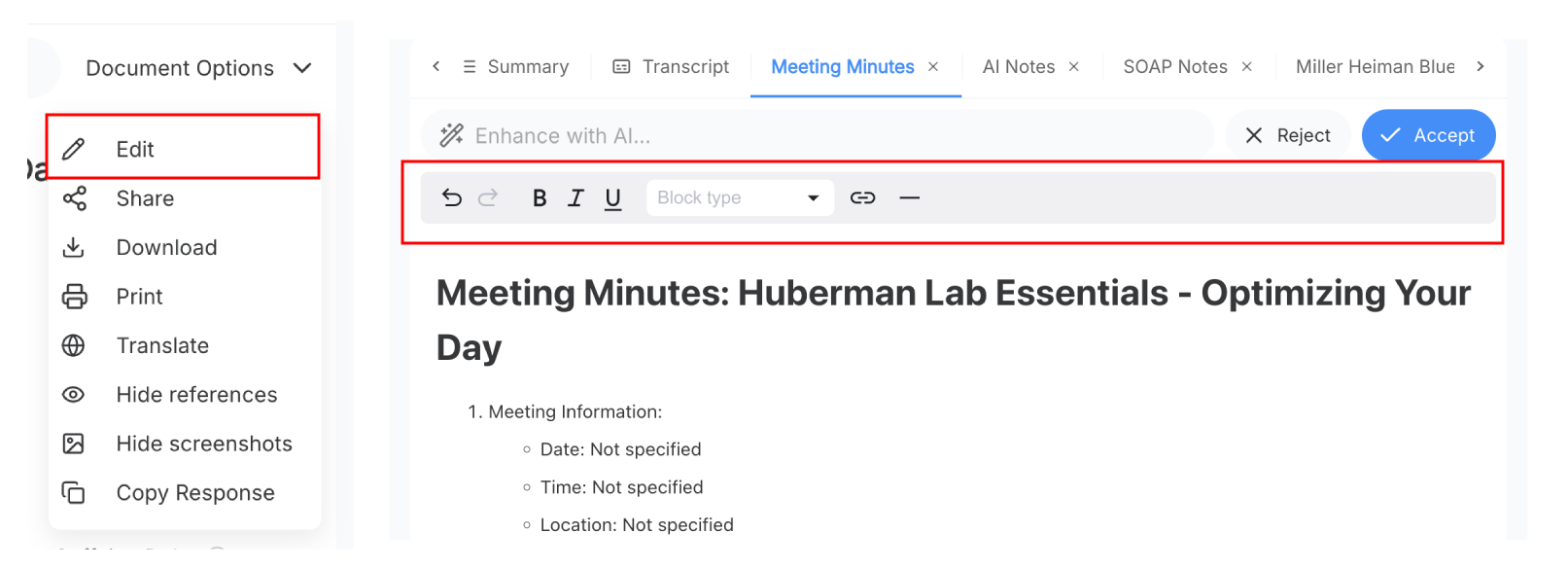
- Edit and Review
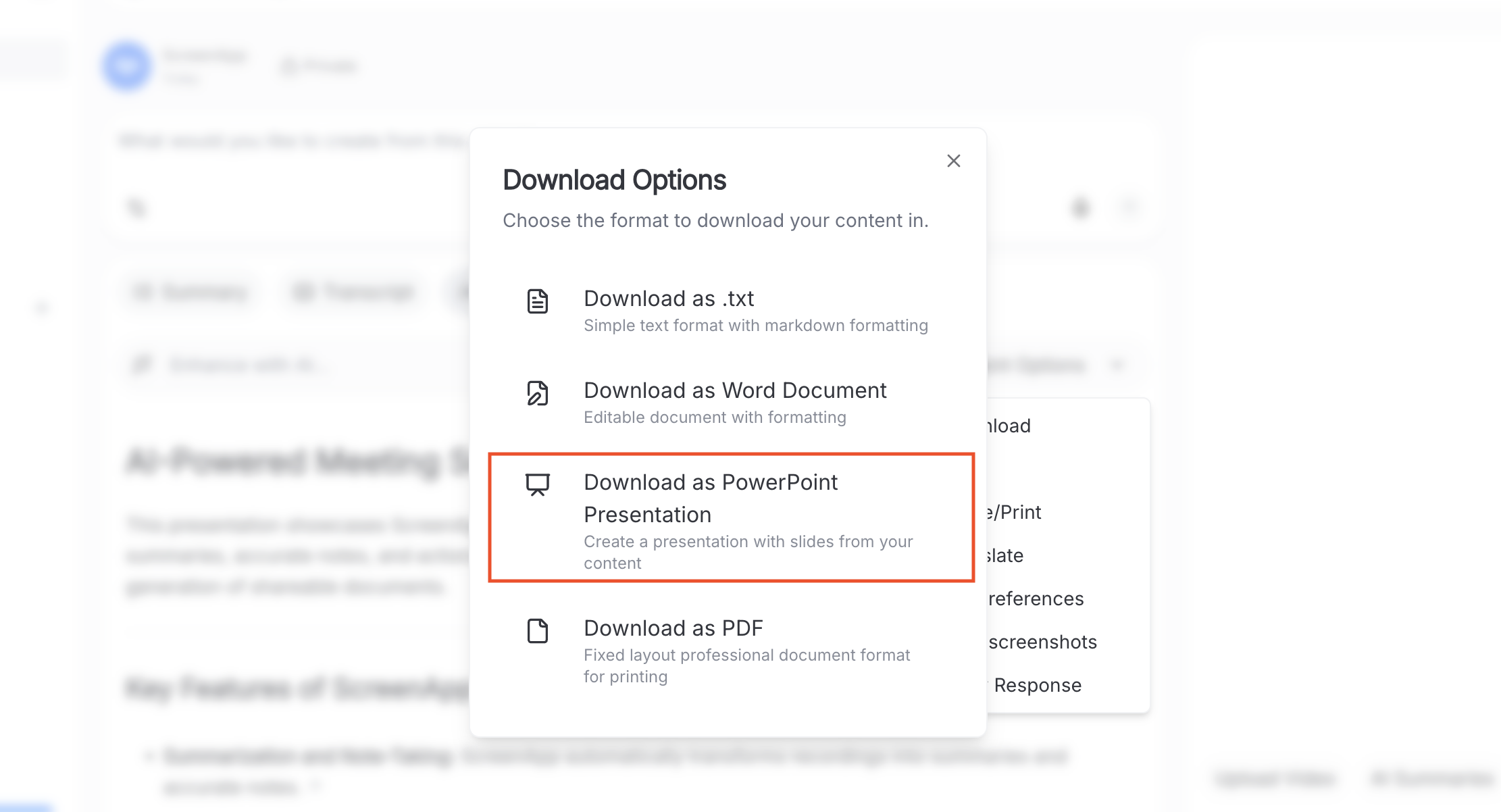
- Download
Here is the complete workflow for converting a video into a PowerPoint presentation using ScreenApp:
Step 1: Upload your video. Drag and drop your MP4, WEBM, or MOV file into ScreenApp. You can also paste a YouTube link directly — no need to download the video first. Cloud storage integrations (Google Drive, Dropbox) are also supported.
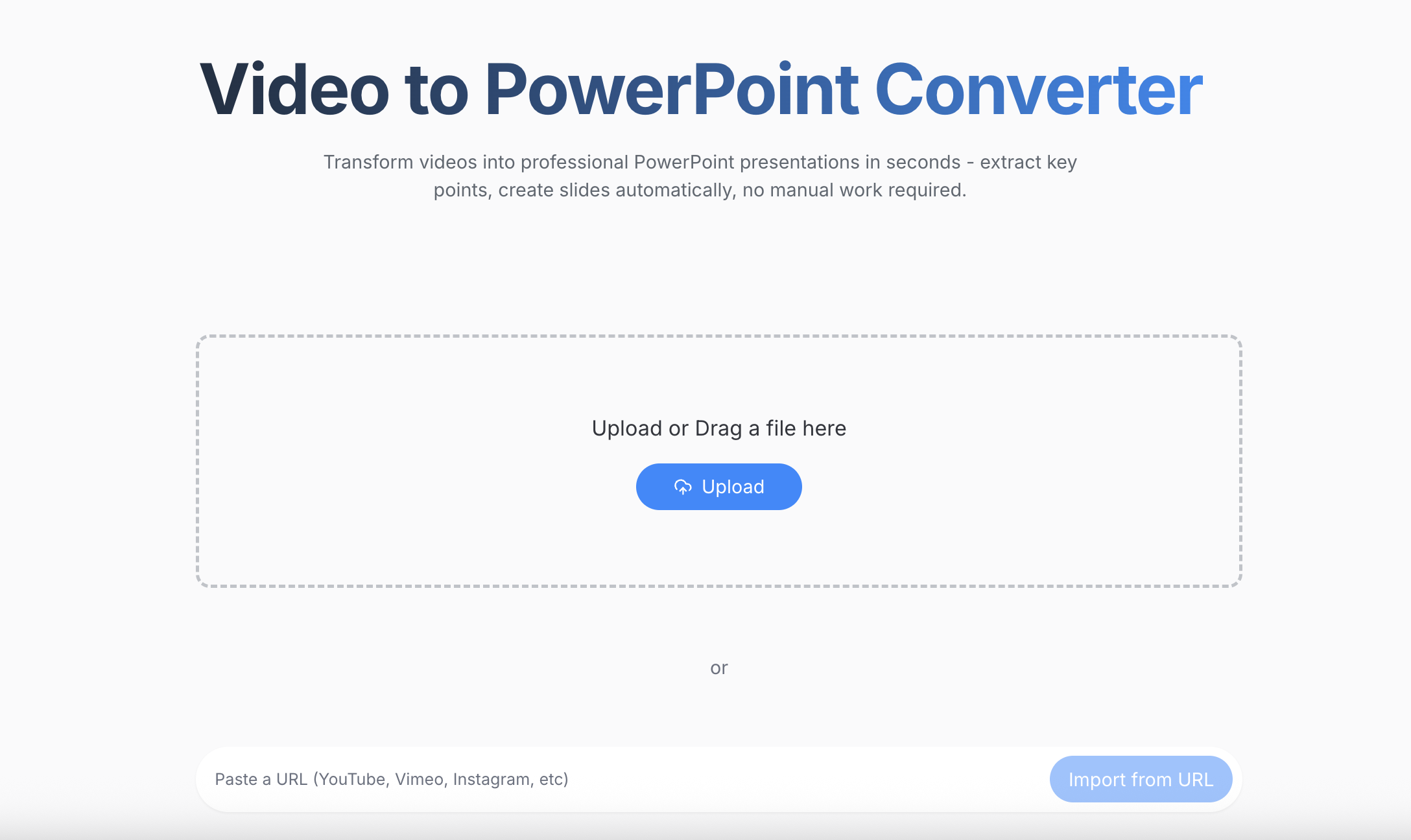
Step 2: Click “Convert and Transcribe.” The AI processes your video in parallel: it transcribes audio, reads on-screen text with OCR, identifies topic boundaries, and captures relevant screenshots. A 10-minute video typically processes in 2-3 minutes.
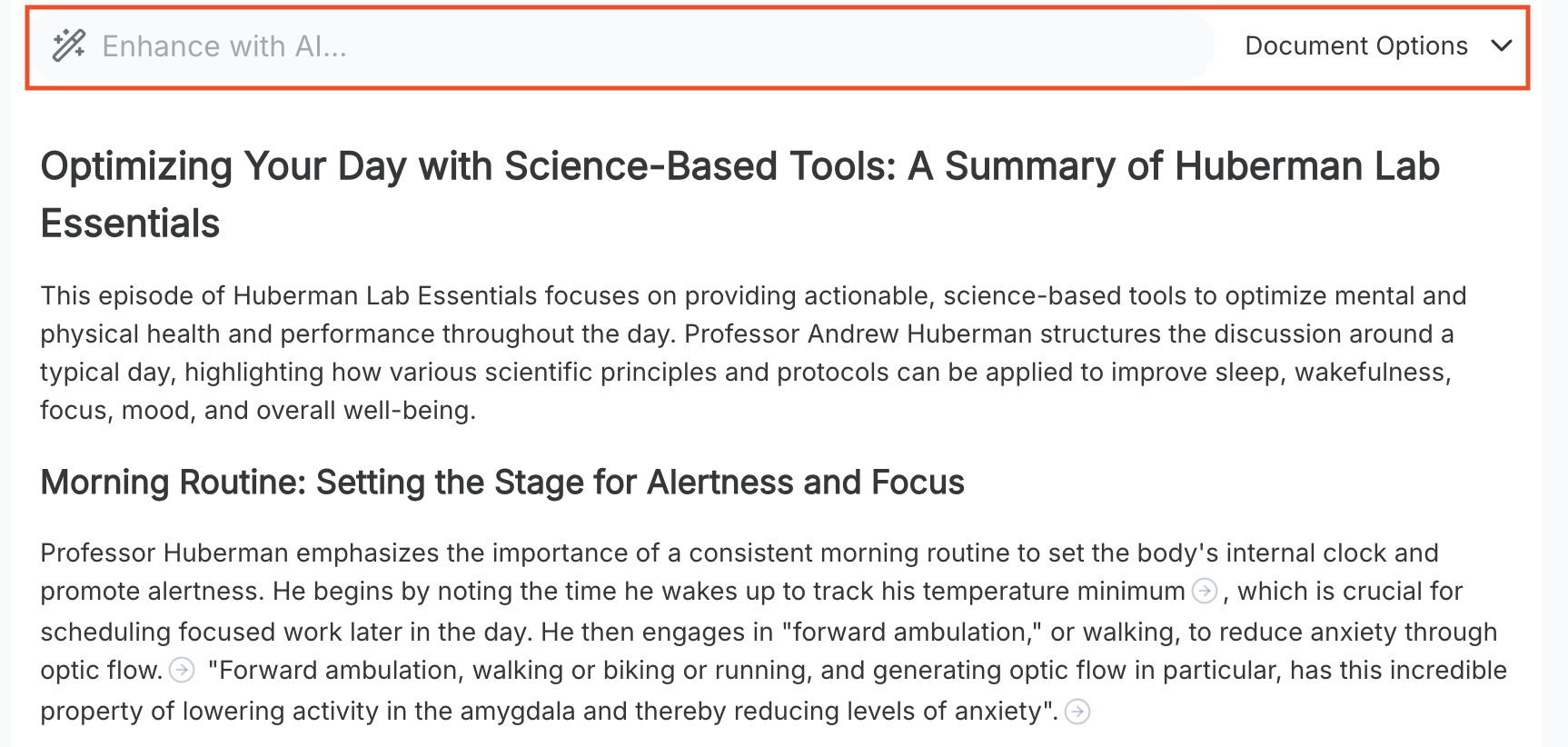
Step 3: Select an AI template. Choose from 50+ templates depending on your use case — lecture notes, step-by-step guide, meeting action items, sales interaction, or project meeting. Each template changes how the AI structures the slide content.
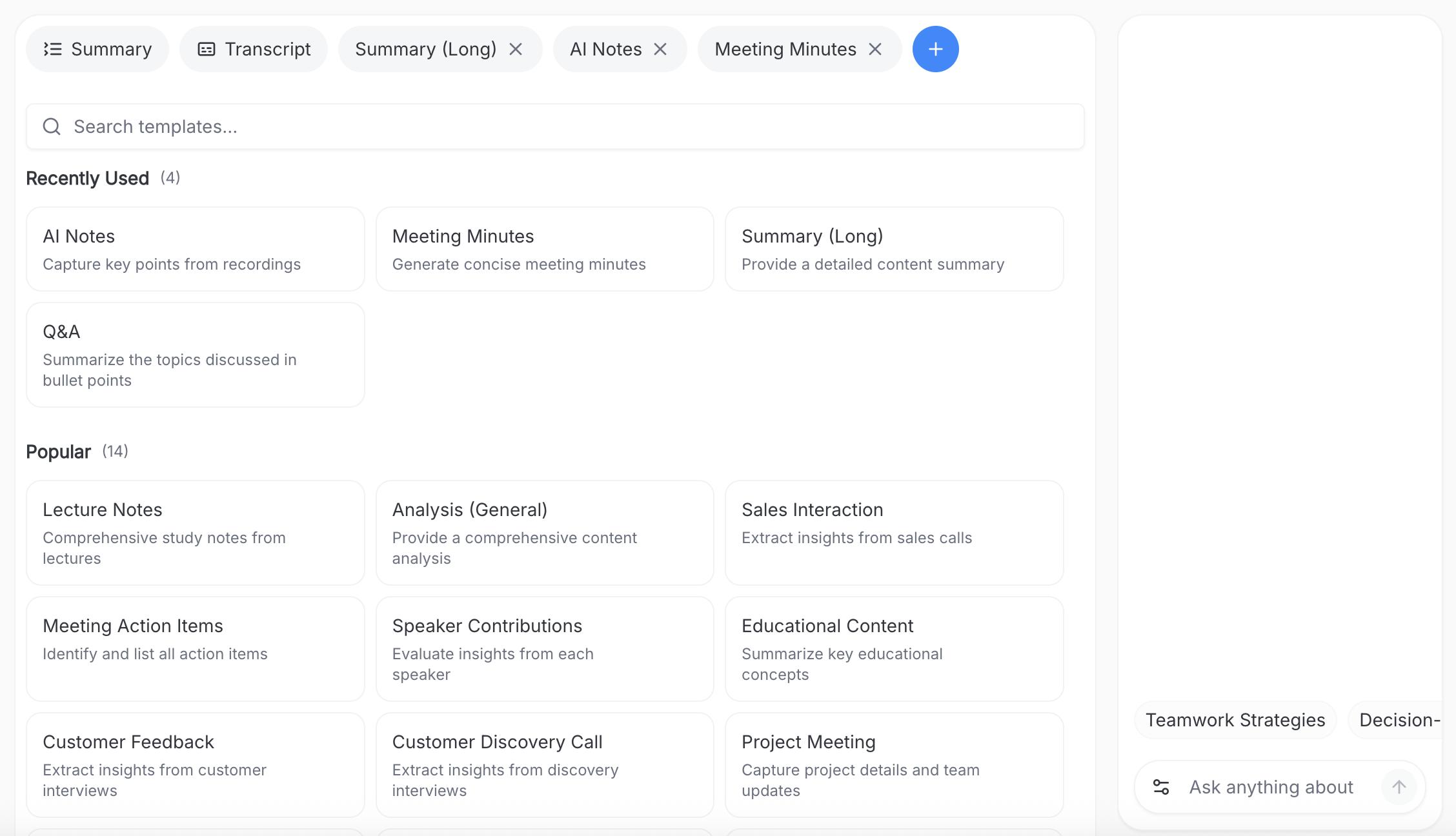
Step 4: Edit and review. Reorder slides, refine titles, add or remove screenshots, and adjust formatting before downloading. You can also translate terminology for different audiences.
Step 5: Download your .pptx file. The finished presentation includes editable slides with structured content, contextual screenshots, and clickable timestamps that link to the original video. It works with PowerPoint, Google Slides, and Keynote.
Ready to convert your first video? Try ScreenApp free with no credit card required. Most users create their first presentation in under 5 minutes.
7 Best Video to PPT Converters
We tested each tool by converting the same 20-minute training video and comparing the output quality, ease of use, and pricing.
1. ScreenApp
ScreenApp is the only tool we tested that combines transcription, OCR, and direct .pptx export in a single workflow. Upload a video or paste a YouTube link, and it produces a fully editable PowerPoint with one slide per topic, complete with summarized text and screenshots. The clickable timestamps that link each slide back to the original video moment are genuinely useful for training materials.
What it does well: Complete pipeline from video to finished slides. OCR reads on-screen text from screen recordings, which none of the other tools except Video2PPT can do. YouTube link support means no downloading.
Where it falls short: Processing longer videos (60+ minutes) can take 10-15 minutes. AI-generated slides sometimes need manual cleanup on slide titles. Requires internet connection.
Pricing: Free plan (1 transcript/month, 45 min per recording). Growth plan $14/mo billed annually ($30/mo monthly). Professional plan $34/mo billed annually ($69/mo monthly). Students get 50% off annual plans.
Best for: Professionals, trainers, and educators who regularly convert training videos, lectures, or webinars into slide decks.
2. Video2PPT
Video2PPT is a Chrome extension and web tool that processes videos entirely on your local device. No data gets uploaded to any server, which makes it the best option if you’re working with confidential content like student recordings or internal company videos.
What it does well: All processing happens locally, so there are zero privacy concerns. Supports videos up to 40 GB. Free plan includes all core features. Exports to PowerPoint, Google Slides, PDF, and HTML.
Where it falls short: Processing speed depends on your device hardware. No audio transcription — it focuses on extracting visual frames and on-screen text. Free plan limited to 200 MB videos and 30 slides.
Pricing: Free plan ($0, 200 MB limit, 30 pages max). Pro plan $5/mo (unlimited video size, up to 512 pages, batch conversion).
Best for: Users who need privacy-first processing for sensitive or confidential video content.
3. SlidesPilot
SlidesPilot is purpose-built for converting YouTube videos into presentation slides. Paste a YouTube URL, and it summarizes the video content into editable slides. It also works with video lectures and can customize the output by length, focus, and tone.
What it does well: YouTube URL support is smooth. You can specify how many slides you want and what to focus on. Over 3 million users, so the product is mature.
Where it falls short: Primarily YouTube-focused — MP4 uploads are limited. Slide designs are basic and often need visual polish. Free trial is limited.
Pricing: Free trial available. Pro plan $15/mo billed annually (unlimited conversions and exports).
Best for: Students and researchers who want to turn YouTube lectures or tutorials into study slides.
4. MagicSlides
MagicSlides is a Google Slides add-on with over 1 million installs. It can create presentations from YouTube videos, PDFs, text, and URLs. The Google Slides integration means you can work directly in your browser without downloading any files.
What it does well: Tight Google Slides integration. Works with multiple input types (YouTube, PDF, text). Fast generation — most presentations ready in under 2 minutes.
Where it falls short: Several user reviews mention thin content on generated slides. Graphics don’t always match the topic. Some users report occasional generation failures. No direct MP4 upload.
Pricing: Free plan (limited features). Pro plan starts at $8/mo billed annually. Premium $29/mo for advanced features. See MagicSlides pricing for details.
Best for: Google Workspace users who want a quick first draft of slides from a YouTube video without leaving their browser.
5. Veed.io
Veed.io is a browser-based video editor with a strong auto-transcription feature. It doesn’t generate PPT files directly, but you can download the full transcript for free and use it to build your presentation manually or with ChatGPT. The real value is if you need to edit your video AND extract text for slides in the same tool.
What it does well: Combines video editing with accurate transcription. Free plan available. Fast transcription with good accuracy. Auto-generated subtitles you can export.
Where it falls short: No automatic slide generation — you get a transcript, not a PPT. Free plan adds a watermark to edited videos. 720p export limit on free plan.
Pricing: Free plan ($0, watermark, 720p, 10 min limit). Lite $12/user/mo (1080p, no watermark). Pro $29/user/mo (4K, AI video generation, background removal).
Best for: Video editors who need to trim, subtitle, and transcribe a video before manually building a presentation from the transcript.
6. Pictory.ai
Pictory.ai is an AI video repurposing platform built for marketers. It can transcribe a long video, summarize it, and create short social clips from it. Like Veed, it doesn’t have a direct video-to-PPT button, but you can export the transcript and use it for slides.
What it does well: Excellent at turning long videos into short social clips. High-accuracy transcription. Good for content marketers who need both clips and transcripts.
Where it falls short: No direct PPT export. No free plan (14-day trial only). Primarily designed for video creation, not documentation.
Pricing: Starter $19/mo billed annually ($23/mo monthly, 30 videos/month). Professional $39/mo billed annually ($47/mo monthly, 60 videos/month). Teams $99/mo billed annually ($119/mo monthly).
Best for: Marketing teams that need to repurpose webinars and long videos into social content, with transcription as a secondary benefit.
7. Vizle
Vizle (govizle.com) extracts frames from videos and turns them into PDF or PPT documents. It has processed over 500,000 videos across 180+ countries. The tool works well for lecture recordings where slides are already visible on screen — it captures those frames and reconstructs them.
What it does well: Good at recovering slides that are already visible in the video. Supports YouTube, Vimeo, and uploaded files. PPT and PDF export.
Where it falls short: Works best when the video already contains visible slides. Doesn’t transcribe audio or generate new content. Per-video pricing can add up.
Pricing: Free tier with limitations. Pro plan around $10/video for up to 2-hour videos. Bulk discounts available.
Best for: Anyone who recorded a presentation and needs to recover the original slides from the video footage.
ChatGPT Method (Free DIY)
You can’t upload a video directly to ChatGPT or Claude. But you can use a free transcript tool — like ScreenApp’s transcription feature or YouTube’s built-in transcript — and then paste the text into ChatGPT with a prompt like:
“Turn this transcript into a 10-slide presentation with a title slide, one slide per main topic, and a summary slide.”
This is completely free but requires manual copy-pasting and formatting. You’ll also need to create the actual PPT file yourself in PowerPoint or Google Slides.
What About ILovePDF?
A lot of people search for “video to ppt converter I Love PDF,” but ILovePDF doesn’t do video conversion. It’s a PDF manipulation tool (merge, split, compress, convert PDFs). For video to PPT, you need a dedicated tool from the list above.
Try ScreenApp for Video to PPT
If you regularly need to turn videos into presentations, ScreenApp’s video to PPT converter handles the entire workflow in one place. Upload your video or paste a YouTube link, and get an editable .pptx file in minutes.
Join 2M+ users who save hours every week converting videos to presentations. The free plan lets you try it without a credit card.
No risk. Free tier includes everything you need to test the full workflow. Upgrade only when you’re converting videos regularly.
FAQ
How do I convert a YouTube video to PPT for free?
Paste the YouTube URL into ScreenApp or SlidesPilot. Both accept YouTube links directly — you don’t need to download the video first. ScreenApp’s free plan includes one conversion per month. You can also use YouTube’s free transcript feature, copy the text, and paste it into ChatGPT to generate slide content manually.
What video formats do these converters support?
Most AI video to PPT converters support MP4, WEBM, MOV, AVI, and MKV. ScreenApp and Video2PPT both accept all common formats. ScreenApp also accepts YouTube links directly, and Video2PPT supports TikTok and Vimeo links. Check each tool’s upload page for the full format list.
Can these tools read text from screen recordings?
Only tools with OCR (Optical Character Recognition) can read visible text from your screen. ScreenApp and Video2PPT both have OCR. This matters for silent screen recordings where there’s no audio narration — the tool reads text from the UI, code, charts, or slides shown on screen. Most other converters rely on audio transcription only, so they produce empty results for silent recordings.
Does ILovePDF convert video to PPT?
No. ILovePDF is a PDF tool for merging, splitting, and compressing PDF files. It doesn’t handle video files at all. For video to PPT conversion, use a dedicated tool like ScreenApp, Video2PPT, or SlidesPilot.
How long does video to PPT conversion take?
For cloud-based tools like ScreenApp, a 10-minute video processes in about 2-3 minutes. A 1-hour webinar takes roughly 10-15 minutes. Video2PPT processes locally on your device, so speed depends on your hardware — a modern laptop handles a 30-minute video in under 5 minutes. All cloud tools let you do other work while processing runs in the background.
Are the generated PPT files editable?
Yes. Tools that export .pptx files (ScreenApp, Video2PPT, SlidesPilot, MagicSlides) produce fully editable presentations. You can open them in PowerPoint, Google Slides, or Keynote and change text, reorder slides, add images, or apply your own design template. The AI gives you a solid first draft, but you’ll usually want to polish slide titles and formatting before presenting.
How do I convert video to PPT in Canva?
Canva doesn’t have a video-to-PPT converter. The workaround is a two-step process: first, convert your video to .pptx using ScreenApp or Video2PPT. Then import the .pptx file into Canva to apply Canva’s design templates and visual effects. This gives you AI-generated content from the video plus Canva’s design tools.
Next Steps
Once you have your slides, you might also find these guides useful:
FAQ
Paste the YouTube URL into ScreenApp or SlidesPilot. Both accept YouTube links directly -- you don't need to download the video first. ScreenApp's free plan includes one conversion per month. You can also use YouTube's free transcript feature, copy the text, and paste it into ChatGPT to generate slide content manually.
Most AI video to PPT converters support MP4, WEBM, MOV, AVI, and MKV. ScreenApp and Video2PPT both accept all common formats. ScreenApp also accepts YouTube links directly, and Video2PPT supports TikTok and Vimeo links. Check each tool's upload page for the full format list.
Only tools with OCR (Optical Character Recognition) can read visible text from your screen. ScreenApp and Video2PPT both have OCR. This matters for silent screen recordings where there's no audio narration -- the tool reads text from the UI, code, charts, or slides shown on screen. Most other converters rely on audio transcription only, so they produce empty results for silent recordings.
No. ILovePDF is a PDF tool for merging, splitting, and compressing PDF files. It doesn't handle video files at all. For video to PPT conversion, use a dedicated tool like ScreenApp, Video2PPT, or SlidesPilot.
For cloud-based tools like ScreenApp, a 10-minute video processes in about 2-3 minutes. A 1-hour webinar takes roughly 10-15 minutes. Video2PPT processes locally on your device, so speed depends on your hardware -- a modern laptop handles a 30-minute video in under 5 minutes. All cloud tools let you do other work while processing runs in the background.
Yes. Tools that export .pptx files (ScreenApp, Video2PPT, SlidesPilot, MagicSlides) produce fully editable presentations. You can open them in PowerPoint, Google Slides, or Keynote and change text, reorder slides, add images, or apply your own design template. The AI gives you a solid first draft, but you'll usually want to polish slide titles and formatting before presenting.
Canva doesn't have a video-to-PPT converter. The workaround is a two-step process: first, convert your video to .pptx using ScreenApp or Video2PPT. Then import the .pptx file into Canva to apply Canva's design templates and visual effects. This gives you AI-generated content from the video plus Canva's design tools.